









Manufacturing stone coated metal roof tiles requires synchronized processing of multiple material layers—galvalume substrate, acrylic adhesive, and ceramic granules—within a continuous production environment. Modern production lines address this complexity through modular station design, enabling facilities to scale output while maintaining product consistency.
Material Preparation and Profile Formation
 a
a
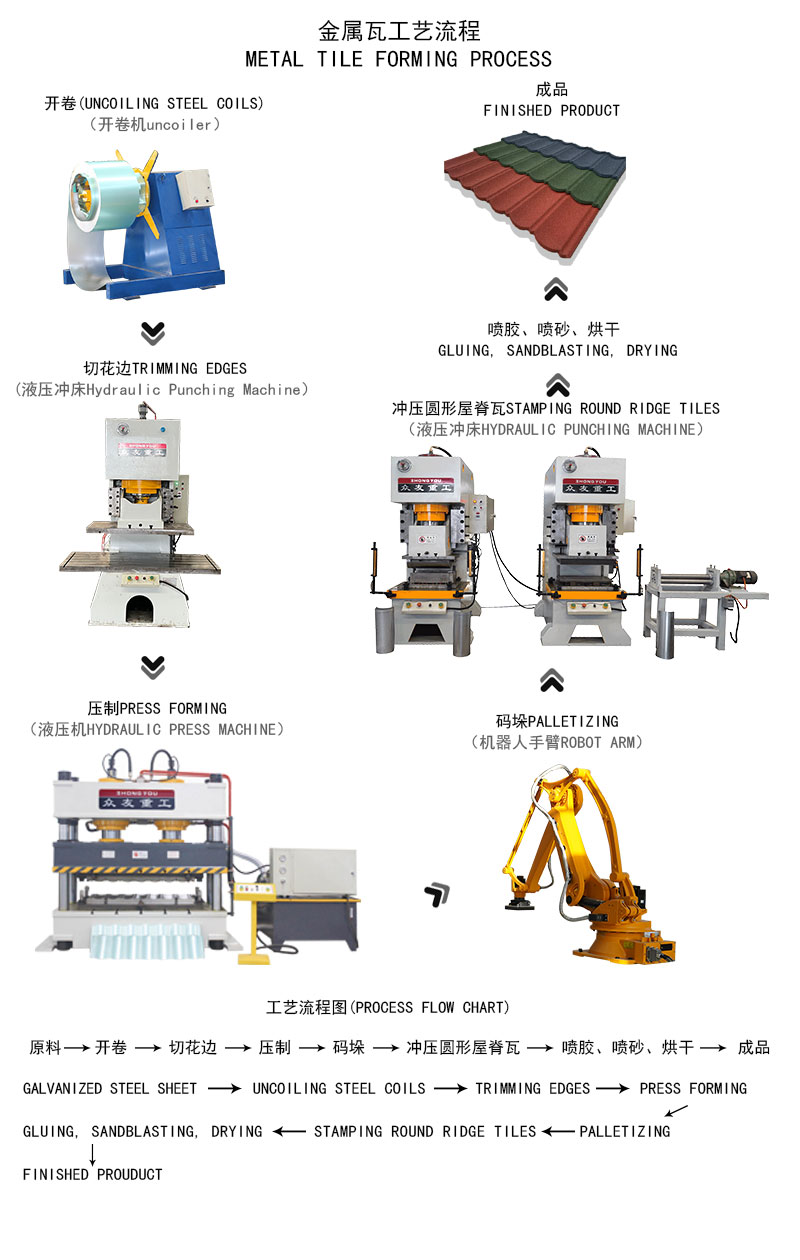
The initial processing stage handles 0.4mm-0.5mm Al-zinc coated steel coils with precise slitting and edge profiling. Decoiler systems feed material into slitting shears that segment coils into specified widths, followed by lace shearing equipment that creates decorative edge patterns. This pre-forming phase proves critical; dimensional accuracy at this stage determines final tile fitment on roofing substrates.
Hydraulic pressing stations form the core of profile generation. Four-column press configurations with 315-ton nominal capacity utilize interchangeable die sets to produce distinct profiles—Bond, Milano, Roman, Shingle, and Wood Shake configurations. The pressing operation must balance forming depth against material thinning; excessive deformation compromises the corrosion-resistant Al-zinc coating integrity.
Surface Treatment and Coating Application
Following mechanical forming, tiles enter the coating section where surface preparation determines adhesion quality. The production line implements a two-stage adhesive process: primer application establishes bonding between metal substrate and granules, while topcoat sealing provides environmental protection.
Automated glue spraying stations employ pneumatic atomization systems with closed-loop pressure control. The primer section typically operates at 0.1-0.6MPa application pressure, ensuring uniform film thickness across complex surface geometries. Sand coating stations utilize induction-activated dispensing hoppers that trigger material release upon tile detection—this sensor-driven approach eliminates continuous flow waste and reduces elevator system loading compared to conventional gravity-fed designs.
Thermal Processing and Quality Assurance
The drying infrastructure represents substantial capital investment, often extending 60-70 meters in lineal dimension. Infrared heating systems with 100-tube arrays maintain 0-160°C programmable temperature zones across initial and secondary curing stages. Horizontal tile orientation within the drying tunnel—rather than longitudinal feeding—increases thermal exposure duration without reducing line speed, addressing the curing requirements of water-based acrylic adhesives.
Recent system improvements include water-circulation dust collection at coating stations, addressing environmental compliance concerns while reducing adhesive particulate accumulation on conveyor chains. Automatic flipping mechanisms at sand coating stations minimize manual handling damage, improving yield rates for high-value textured profiles.
Line Integration and Control Architecture
Complete systems integrate profile forming, coating application, and thermal processing through PLC-coordinated material handling. Chain-based conveyors with variable frequency drive systems maintain 4-10 seconds per piece cycle rates, adjustable through centralized HMI interfaces. This integration enables single-operator monitoring of 200KW+ total installed capacity systems producing 4,000-7,000 units daily.
For facilities evaluating capacity expansion, the critical specification lies not in individual station ratings but in throughput balancing—ensuring that coating application rates match pressing station output without creating intermediate inventory buffers that compromise adhesive pot life.